


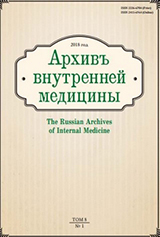
The journal "Archive of Internal Medicine" has been published since 2011 and is aimed at medical specialists in the field of various clinical disciplines (therapy, cardiology, gastroenterology, endocrinology, surgery, neuropathology, infectious diseases, pulmonology, immunology, etc.) and employees of medical universities, institutes of advanced medicine and research institutions. Generalization of scientific and practical achievements in the field of medicine is necessary, therefore, the journal publishes original articles devoted to the study of epidemiology, etiology, and pathogenesis of various diseases, as well as the results of using various treatment methods, as well as reviews of the most relevant studies that serve as a vector for the development of a particular field of medicine.
The Higher Attestation Commission under the Ministry of Science and Higher Education of the Russian Federation takes into account publications in the journal "Archive of Internal Medicine" in the following scientific specialties:
- 3.1.18 Internal diseases
- 3.1.20 Cardiology
- 3.1.27 Rheumatology
- 3.1.29 Pulmonology
It has been indexed in Scopus since 2021.
The journal is indexed in the eLibrary database.EN, information about published articles is regularly transmitted to the Russian Science Citation Index system. The indicators of publication activity of scientific journals for 2022 have been updated. The main scientometric indicators of the journal for 2022:
The five-year impact factor of the RSCI is 1.021;
The five-year impact factor for the core of the RSCI is 0.505;
The journal's score in the SCIENCE INDEX ranking is 6,098;
The ten-year Hirsch index is 20.
All articles on the journal's website are submitted under the terms of the Creative Commons Attribution License, which allows others to distribute this work with the obligatory preservation of links to the authors of the original work and the original publication in this journal.
The journal "Archive of Internal Medicine" is registered with the Ministry of Press, Broadcasting and Mass Media of the Russian Federation (certificate of registration of the mass media PI No. FS77-45961 dated July 26, 2011).
The journal is published 6 times a year.
The printed version is distributed on the territory of the Russian Federation by subscription.
The subscription index in the Ural-Press District catalog is 87732.


Current issue
REVIEW ARTICLES
Rheumatoid arthritis (RA) is a chronic autoimmune disease with a high potential for disability, where early diagnosis is crucial for timely initiation of disease-modifying antirheumatic drugs (DMARDs) and for improving long-term outcomes. In recent decades, particular attention has been paid to serological biomarkers, among which rheumatoid factor (RF) and anti-citrullinated protein antibodies (ACPA), including anti-CCP and anti-MCV, play a leading role. These markers not only confirm the diagnosis but also help predict the risk of aggressive disease course and joint erosions. Modern immunoassay methods have significantly expanded diagnostic opportunities. Along with traditional approaches such as latex agglutination, enzyme-linked immunosorbent assay (ELISA), and turbidimetry, innovative technologies are actively being implemented, including electrochemical impedance spectroscopy (EIS), surface-enhanced Raman spectroscopy (SERS), photoelectrochemical biosensors, and microfluidic platforms. Multiplex immunoassays are of particular importance, as they allow the simultaneous detection of multiple biomarkers in a single sample, thereby increasing diagnostic accuracy, facilitating patient stratification, and promoting the principles of personalized medicine. Despite their advantages, multiplex methods face several limitations: the need for highly specific antibody pairs, the risk of cross-reactivity, the lack of standardized reference materials for ACPA, and challenges in quality control. Future development of these technologies depends on assay standardization, implementation of international reference standards, and optimization of diagnostic thresholds. In conclusion, the integration of modern immunoassay techniques and multiplex platforms into clinical practice provides new opportunities for early diagnosis and prognosis of RA, ultimately reducing disability rates and improving patients’ quality of life.
Background: Diabetes mellitus traditionally classified into type 1 (T1D), type 2 (T2D), gestational, and other specific types. A novel five-cluster model severe autoimmune diabetes (SAID), severe insulin-deficient diabetes (SIDD), severe insulin-resistant diabetes (SIRD), mild obesity-related diabetes (MOD), and mild age-related diabetes (MARD). This new classification was based on six clinical variants: age, body-mass index at diagnosis, glycosylated hemoglobin, glutamic acid decarboxylase antibodies, homeostasis model assessment 2 beta and insulin resistance. This model enhances personalized treatment and complication prediction. Objective: This review evaluates the clinical and therapeutic implications of the five-cluster classification, synthesizing evidence from 2010–2023 to assess its impact on treatment efficacy and personalized care. Methods: This review was limited to the last 15-years and was done using PubMed, Web of Science and Google Scholar. Terms used included “precision therapy,” “diabetes sub-categories,” “SAID,” “SIDD,” “SIRD,” “MOD” and “MIRD.” Only preclinical and clinical data in English were used. Results: The five-cluster model highlights specific clinical trajectories: SIRD is associated with nephropathy, while SAID and SIDD clusters have more complications (e.g., neuropathy, ketoacidosis) severity. The metabolic and organ dysfunction (MARD and MOD) that is more common in obesity, is less severe. Validation studies have brought attention to regional and ethnic disparities in the distribution of SIRD and MOD; specifically, it seems that South Asians have a higher incidence of SIRD than African cohorts, where MOD is more prevalent. In conclusion, by customizing therapeutic applications to metabolic profiles, the five-cluster method promotes precision medicine; therapy ought to be in line with biology.
ORIGINAL ARTICLE
The aim of this study was to investigate the association between the presence of chronic bronchitis (CB) and blood adipokine levels in individuals aged 25-44 years with and without abdominal obesity (AO). The study was conducted on a population-based sample of 1,415 residents of Novosibirsk. After excluding individuals with documented broncho-obstruction and missing spirometry data, a subsample of 1,086 individuals aged 37.8 [32.0; 41.9] years was formed for analysis. All individuals underwent anthropometry, anamnesis collection, and blood collection from the cubital vein to determine lipid profile, glucose, and adipokine levels. CB was diagnosed based on a standard epidemiological questionnaire in the presence of a cough with sputum for at least 3 months per year or with a medical history of the disease. Results. Individuals with chronic bronchitis and oxidative stress had higher systolic blood pressure (SBP) (p=0.001) and diastolic blood pressure (DBP) (p=0.003), atherogenic changes in the lipid profile (higher levels of low-density lipoprotein cholesterol (LDL-C), triglycerides (TG), and low levels of high-density lipoprotein cholesterol (HDL-C)) and higher glucose levels compared to individuals without oxidative stress. The likelihood of having chronic bronchitis was associated with smoking, oxidative stress, and increased SBP. When studying the concentration of blood adipokines in individuals with and without CB, it was found that individuals with CB and AO had higher levels of resistin (p=0.023), amylin (p=0.041), interleukin 6 (IL-6) (p=0.002), C-peptide (0.0001), insulin (p=0.035), leptin (p=0.0001), tumor necrosis factor alpha (TNFα) (p=0.003) and glucagon-like peptide 1 (GLP-1) (p=0.001) compared to individuals with CB and without AO. Univariate logistic regression analysis revealed that the odds of having CB were inversely associated with the levels of resistin (OR 0.998 CI 0.997-0.999) and peptide YY (PYY) (OR 0.994 CI 0.989-0.999); the models were adjusted for gender, age, waist circumference (WC), and smoking status. When both molecules were included in the multivariate logistic regression analysis model along with AO, SBP, smoking, gender, and age, associations were obtained only for resistin (OR 0.998 CI 0.997-0.999) and smoking (OR 4.656 CI 2.802-7.738). Conclusion. In individuals aged 25-44 years, the odds of having chronic kidney disease are directly associated with smoking and AO, and inversely associated with the blood concentration of resistin, regardless of gender and age.
To identify early clinical and metabolic predictors of gestational diabetes mellitus (GDM) and preeclampsia in the first trimester of pregnancy and to justify the need for a personalized screening strategy. Materials and Methods: A retrospective case-control cohort study was conducted at the Multidisciplinary City Hospital No. 2 in Astana (n=600). The main group consisted of 300 pregnant women with GDM, and the control group comprised 300 women with physiological pregnancy. Anthropometric data (BMI), medical history, and laboratory indicators (fasting glucose, HbA1c) recorded at registration (up to 12 weeks) were analyzed. Statistical analysis included the Mann-Whitney U-test, odds ratio (OR) calculation, and ROC analysis. Results: Patients with GDM had significantly higher BMI (obesity in 31.0 % vs. 9.0 %, p<0.001) and age. The incidence of preeclampsia in the GDM group was 7.3 % vs. 3.3 % in the control group; it was established that GDM increases the risk of preeclampsia by more than two times(OR=2.295; 95 % CI: 1.067–4.934). ROC analysis revealed high diagnostic value of individual markers in the first trimester. Fasting glucose at a threshold of >4.49 mmol/L showed a sensitivity of 71.6 % and specificity of 76.6 % (AUC=0.787; 95 % CI: 0.745–0.825). Glycated hemoglobin (HbA1c) at a level >5.27 % demonstrated a sensitivity of 63.9 % and high specificity of 85.7 % (AUC=0.792; 95 % CI: 0.653–0.894). The developed combined prognostic model (HbA1c + fasting glucose) showed the highest predictive value with an area under the ROC curve (AUC) of 0.849, providing a sensitivity of 90.0 % and specificity of 78.2 %. Conclusion: Glycated hemoglobin and fasting glycemia in the first trimester are independent predictors of GDM and associated preeclampsia. Implementing a risk score assessment at the first antenatal visit allows for the identification of a group for early initiation of personalized prevention, without waiting for the standard OGTT timing (24–28 weeks), which may reduce the incidence of obstetric complications.
The purpose of the study was to investigate the indicators of general and primary incidence of spondyloarthritis, including ankylosing spondylitis and psoriatic arthritis, among the adult population of the Orenburg region during the period from 2019 to 2023. Materials and Methods. The reporting forms of federal statistical monitoring No. 12 “Information on the number of diseases registered in patients residing in the service area of the healthcare organization” were analyzed for the period from 2019 to 2023 among the adult population of the Orenburg region. This analysis assessed the general and primary incidence of the entire group of diseases of the musculoskeletal system and connective tissue, including spondyloarthropathies, such as ankylosing spondylitis, as well as skin and subcutaneous tissue diseases, including psoriatic arthritis. Results. During the study period, a trend was established among the adult population of the Orenburg region for an increase in both the general and primary incidence of musculoskeletal system and connective tissue diseases, as well as spondyloarthropathies, in 2023 compared to 2019. From 2020 to 2022, a decrease in these indicators was recorded. The dynamics of the general incidence of ankylosing spondylitis (AS) were ambiguous : it was higher in 2019 than in 2023. The primary incidence of AS increased by 2023. There was a noted trend toward an increase in the overall and primary incidence of skin and subcutaneous tissue diseases and psoriatic arthritis (PsA) in 2023 compared to 2019, with a decrease in this indicator during the pandemic from 2020 to 2022. Several differences were identified when comparing the indicators of overall and primary incidence of musculoskeletal system and connective tissue diseases, spondyloarthropathies, AS, skin and subcutaneous tissue diseases, and PsA between the Orenburg region and the Russian Federation. Conclusion. The obtained data underscore the necessity for further epidemiological studies concerning axial spondyloarthritis, as well as the optimization of diagnosis, monitoring, and the progression of these diseases.
Ankylosing spondylitis (AS) is a chronic inflammatory disease characterized by damage to the axial skeleton, peripheral joints and periarticular apparatus, manifestation of systemic manifestations with predominant involvement of the vascular membrane of the eye, skin with the development of psoriasis and intestines. AU is characterized by an earlier onset of arterial hypertension (AH), as well as a higher level of cardiovascular risk (CVR) associated with AH. Endothelial dysfunction as the initial stage of the development of cardiovascular diseases (CVD) can occur due to the activation of the prohormone renin and high activity of angiotensin (Ang) II. Ang II is involved not only in the regulation of blood pressure, but also performs hematopoietic functions, mainly erythropoiesis and myelopoiesis. Several studies have shown the association of AGTR1 (1166A>C) angiotensin II type 1 receptor polymorphism with hypertension, vasoconstriction, and sodium retention in the body. Therefore, it is potentially important to evaluate the role of oligonucleotide polymorphism (SNP) A1166C of the AGTR1 gene in the clinical manifestation of AS, as well as its significance in the development of comorbid pathology and the formation of CVR, including hypertension. Aim: to evaluate the effect of the A1166C polymorphism of the AGTR1 gene on the development of comorbid pathology and the formation of CFS, including AH. Materials and methods: The study included 176 patients diagnosed with AS. Genotyping was carried out according to the A1166C polymorphism of the AGTR1 gene by the polymerase chain reaction method (PCR). The statistical analysis was carried out using the Kruskal-Wallis criterion. Results: Patients with the AA genotype had a higher BASMI (Bath Ankylosing Spondylitis Metrology Index) (p=0024, p1,3=0.023). CC homozygotes had lower levels of red blood cells (p=0.025, p2,3=0.02) and hemoglobin (p=0.031, p2,3=0.042), while AA genotypes had lower platelet counts (p=0.0001, p1,3=0.001). Higher glucose levels were recorded in CC homozygotes (p=0,0001, p1,3=0,001, p1,2=0,025), triglycerides — in heterozygotes AC (p=0.038). The highest incidence of enthesitis was recorded for patients with the CC genotype (p2,3=0.006, p=0.015). High incidence of hypertension (p1,2=0.05, p=0.025), dyslipidemia (p1,2=0.012, p2,3=0.006, p=0.031) was found in heterozygotes of AC. Diabetes mellitus was detected only among patients with the CC genotype(p1,3=0.007, p=0.017). Kidney damage was more often detected in carriers of the A allele (p1,3=0.015, p2,3=0.004, p=0.023). Statistical differences were found in the frequency of detection of individual degrees of hypertension (p=0.0001): in heterozygotes of AC — 2 (AA 26 (27.1 %); AC 4 (33.3 %); CC 14 (24.1 %)) and grade 3 (AA 0 (0.0 %) versus AC 2 (16.7 %) CC 0 (0.0 %), p1,2<0.001, p2,3=0.004). Conclusion: The obtained results reveal a wide range of functions of the SNP 1166A>C of the AGTR1 gene, extending beyond participation in the formation of hypertension, and include the regulation of hematopoiesis, metabolic parameters, glucose and lipids in particular, and the formation of comorbid pathology in the form of diabetes mellitus, dyslipidemia, kidney pathology in patients with AS, which determines the potential and feasibility of genotyping patients with AS with the identification of SNPs in order to personalize approaches to pharmacotherapy of AS and monitoring these indicators in the presence of a risk of developing conditions associated with this SNP.
ANALYSIS OF CLINICAL CASES
For the first time, a combination of Kikuchi-Fujimoto’s disease with general variable immune deficiency and multiple sclerosis has been described. The patient’s primary immunodeficiency, accompanied by frequent and severe exacerbations of chronic diseases, led to a protracted diagnostic search. The case highlights the importance of timely morphological examination in persistent lymphadenopathy, even in patients with known immune disorders.
Brentuximab vedotin-induced inflammatory demyelinating polyradiculoneuropathy is a rare chemotherapy side effect. The underlying cause of disease is thought to be pathological drug effects on the humoral immune system. The typical clinical picture is characterized by progressive development of flaccid tetraparesis and severe polyneuritic manifestations, which typically leads to disability and significant impairment in quality of life. Nerve conduction study results show evidence of generalized primary demyelination, including conduction block and sural sparing pattern.Clinical and anamnestic data and objective observational findings are similar to the clinical and neurophysiological pattern observed in acute or recurrent inflammatory demyelinating polyradiculoneuropathies. It is important to emphasize that brentuximab vedotin-induced inflammatory demyelinating polyradiculoneuropathy response to accepted in guidelines pathogenic therapy, which includes corticosteroids, intravenous human immunoglobulin therapy and extracorporeal hemocorrection methods. Clinicians should be aware of treatment possibilities due to reversibility of neurological impairment through the pathogenetic immunosuppressive therapy. This clinical case represents a case of brentuximab-induced inflammatory demyelinating polyradiculoneuropathy with progressive development of severe motor impairment, which led to complete immobilization over 6 months. This clinical case report demonstrates optimal management strategy: timely administration of pathogenetic therapy with appropriate dosing, slow and gradual reduction in corticosteroid dosage. Competent management strategy ensures favorable outcome of the curable druginduced polyradiculoneuropathy.
Announcements
2025-11-17
Dear authors!
- Systematic reviews and meta-analyses.
- Reviews presenting a fundamentally new concept or analysis of previously unorganized data.
| More Announcements... |

ISSN 2411-6564 (Online)





